References · Evidence
Sources and
credits.
Sources are linked beside the content they support. Image credits name the holding institution or photographer, the license, and the source page.
Historical and primary sources
Entries follow APA 7 where metadata is available. Dates are omitted where the source does not establish them; “n.d.” means no date supplied.
- Cress, J. D. (c. 1899). Entrance to the walled city, Manila, near the Pasig River [Photograph]. Library of Congress. LC-USZ62-60796. No known restrictions on publication. ↗
- National Commission for Culture and the Arts. (2003). Nation observes 142nd birth anniversary of Jose Rizal. ↗
- National Historical Commission of the Philippines. (n.d.). Ateneo de Manila [Historical marker]. ↗
- National Museum of the Philippines. (n.d.). Diploma awarded to Dr. Jose Rizal. ↗
- Philippine Embassy in Madrid. (n.d.). Jose Rizal’s walking tour Madrid. ↗
- National Museum of the Philippines. (n.d.). Heldenreise: Dr. Jose Rizal’s time in Germany. ↗
- Ravin, T. B. (2001). José Rizal: Philippine national hero and ophthalmologist. Archives of Ophthalmology, 119(2), 280–284. ↗
- Intramuros Administration. (n.d.). Museo ni Rizal. ↗
- National Historical Commission of the Philippines. (2015). La Liga Filipina [Historical marker]. ↗
- City Government of Dapitan. (n.d.). Rizal Shrine. ↗
- National Commission for Culture and the Arts. (2003). Andres Bonifacio and the 1896 Revolution. ↗
- National Historical Commission of the Philippines. (n.d.). Jose Rizal (DOST Taguig City) [Historical marker]. ↗
- Rizal, J. (1912). The social cancer (C. E. Derbyshire, Trans.). Philippine Education Company. (Original work published 1887). Project Gutenberg. ↗
- Rizal, J. (1912). The reign of greed (C. E. Derbyshire, Trans.). Philippine Education Company. (Original work published 1891). Project Gutenberg. ↗
- Republic Act No. 1425. (1956, June 12). Supreme Court E-Library. ↗
- Constitution of the Republic of the Philippines. (1987). Arts. II, III, XI, XIV. Supreme Court E-Library. ↗
- Library of Congress. (n.d.). Jose Rizal, 1861–1896, bust portrait, facing left [Photograph]. Prints and Photographs Division. ↗
Reading notes
The novels are primary literary sources, not transparent records of events. Character symbolism and significance notes are interpretations. Derbyshire’s 1912 translations use period language; his introduction should be distinguished from Rizal’s text. Consult your course edition for translation differences.
The timeline uses years or ranges when a day is not verified. The trial entry is dated to December 1896 rather than assigning an unsupported exact day. Modern comparisons use constitutional text, not unsourced claims about contemporary outcomes.
Image provenance
Every image below is either an archival reproduction, a photograph of a present-day site, or a photograph of a public-domain edition. No AI-generated historical image or reconstructed first-edition cover is presented as evidence. Modern photographs are labeled as present-day views and do not show what Rizal saw.
- The project’s primary archival portrait of Rizal, from the Library of Congress.
Library of Congress, LC-USZ62-43453. No known restrictions on publication. Public domain · source page ↗ - Entrance to the walled city near the Pasig River, cataloged circa 1899. It postdates Rizal’s death.
J. D. Cress, c. 1899. Library of Congress, LC-USZ62-60796. No known restrictions. Public domain · source page ↗ - The 1912 Derbyshire translation of Noli Me Tangere, digitized by Project Gutenberg.
Project Gutenberg ebook 6737. Public-domain edition. Public domain · source page ↗ - The 1912 Derbyshire translation of El Filibusterismo, digitized by Project Gutenberg.
Project Gutenberg ebook 10676. Public-domain edition. Public domain · source page ↗ - José Rizal, studio portrait from the 1890s.
Unknown photographer, 1890s. Public domain. Public domain · source page ↗ - A young Rizal in 1883, around the time he left for Europe.
Portrait dated 1883. Public domain. Public domain · source page ↗ - Rizal in 1891, the year El Filibusterismo appeared in Ghent.
Telesforo Sucgang, 1891. Wikimedia Commons, CC0. CC0 1.0 · source page ↗ - Teodora Alonso y Quintos, Rizal’s first teacher and strongest early influence.
Reproduced in Pascual Hicaro Poblete, Buhay at Mga Ginawa ni Dr. Jose Rizal (1909). Public domain. Public domain · source page ↗ - Francisco Rizal Mercado, the family’s tenant farmer and patriarch.
Reproduced in Pascual Hicaro Poblete, Buhay at Mga Ginawa ni Dr. Jose Rizal (1909). Public domain. Public domain · source page ↗ - The Paciano Rizal monument and tomb in Los Baños. Paciano supported his younger brother’s studies and later joined the revolution.
Ramon FVelasquez, CC BY-SA 3.0, via Wikimedia Commons. CC BY-SA 3.0 · source page ↗ - Josephine Bracken, Rizal’s companion in Dapitan and the subject of continuing historical debate.
Austin Craig, Lineage, Life and Labors of José Rizal (1913). Public domain. Public domain · source page ↗ - Marcelo H. del Pilar, editor of La Solidaridad and a leading voice of the Propaganda Movement.
Unknown photographer, c. 1890. Public domain. Public domain · source page ↗ - Rizal (centre) with Marcelo del Pilar and other Filipino expatriates in Madrid.
Unknown photographer, late nineteenth century. Public domain. Public domain · source page ↗ - Graciano López Jaena, orator and first editor of La Solidaridad.
Jose N. Sevilla, Mga Dakilang Pilipino (1922). Public domain. Public domain · source page ↗ - Andrés Bonifacio, founder of the Katipunan. The only surviving photograph of him.
Chofre y Cia, 1896. Public domain. Public domain · source page ↗ - Antonio Luna, physician, writer, and general of the Philippine Revolution.
Unknown photographer. Public domain. Public domain · source page ↗ - Ferdinand Blumentritt, the Austrian scholar and friend with whom Rizal exchanged a long correspondence.
Onze Musici (1898). Public domain. Public domain · source page ↗ - Dr. Máximo Viola, Rizal’s friend and the financier who helped publish Noli Me Tangere.
Portrait via Geni / Wikimedia Commons, CC BY-SA 4.0. CC BY-SA 4.0 · source page ↗ - Apolinario Mabini, constitutional adviser to the First Philippine Republic.
Unknown photographer, before 1903. Public domain. Public domain · source page ↗ - A pencil sketch of Blumentritt by Rizal, a small trace of their friendship.
José Rizal, before 1896. Public domain. Public domain · source page ↗ - The Rizal Monument at Luneta, the memorial landscape that grew around the execution site.
Bondyag112665, CC BY-SA 3.0, via Wikimedia Commons. CC BY-SA 3.0 · source page ↗ - The same monument in 2024: national memory is also a maintenance project.
Ernest Malsin, CC BY 4.0, via Wikimedia Commons. CC BY 4.0 · source page ↗ - Rizal Park today. The open grounds invite commemoration and everyday public life.
Vyacheslav Argenberg, CC BY 4.0, via Wikimedia Commons. CC BY 4.0 · source page ↗ - The Rizal Shrine in Calamba, a reconstruction of the family house where Rizal was born.
Ralff Nestor Nacor, CC BY-SA 4.0, via Wikimedia Commons. CC BY-SA 4.0 · source page ↗ - Saint John the Baptist Parish Church, Calamba. Rizal was baptized here in 1861.
Ralff Nestor Nacor, CC BY-SA 4.0, via Wikimedia Commons. CC BY-SA 4.0 · source page ↗ - The Rizal Shrine in Dapitan, where exile became a period of medical practice, teaching, and community work.
QuianCagandahan, CC BY 4.0, via Wikimedia Commons. CC BY 4.0 · source page ↗ - The park and shrine at Talisay, Dapitan. Rizal lived here from 1892 until 1896.
Francisco M. Pajares, Jr., CC BY-SA 4.0, via Wikimedia Commons. CC BY-SA 4.0 · source page ↗ - Santiago el Mayor Parish Church, Dapitan: the town’s older institutional landscape.
Project Kisame, CC BY 2.0, via Wikimedia Commons. CC BY 2.0 · source page ↗ - Fort Santiago, Intramuros. Rizal was held here before his trial and execution.
Diego Delso, CC BY-SA 4.0, via Wikimedia Commons. CC BY-SA 4.0 · source page ↗ - The University of Santo Tomas, where Rizal studied philosophy and medicine.
Gerrard Patricio, CC BY-SA 3.0, via Wikimedia Commons. CC BY-SA 3.0 · source page ↗ - Ateneo de Manila today. Rizal’s Ateneo was the earlier Intramuros school, not this modern campus.
Patrick Roque, CC BY-SA 4.0, via Wikimedia Commons. CC BY-SA 4.0 · source page ↗ - Heidelberg: the old town and castle above the Neckar, where Rizal studied ophthalmology in 1886.
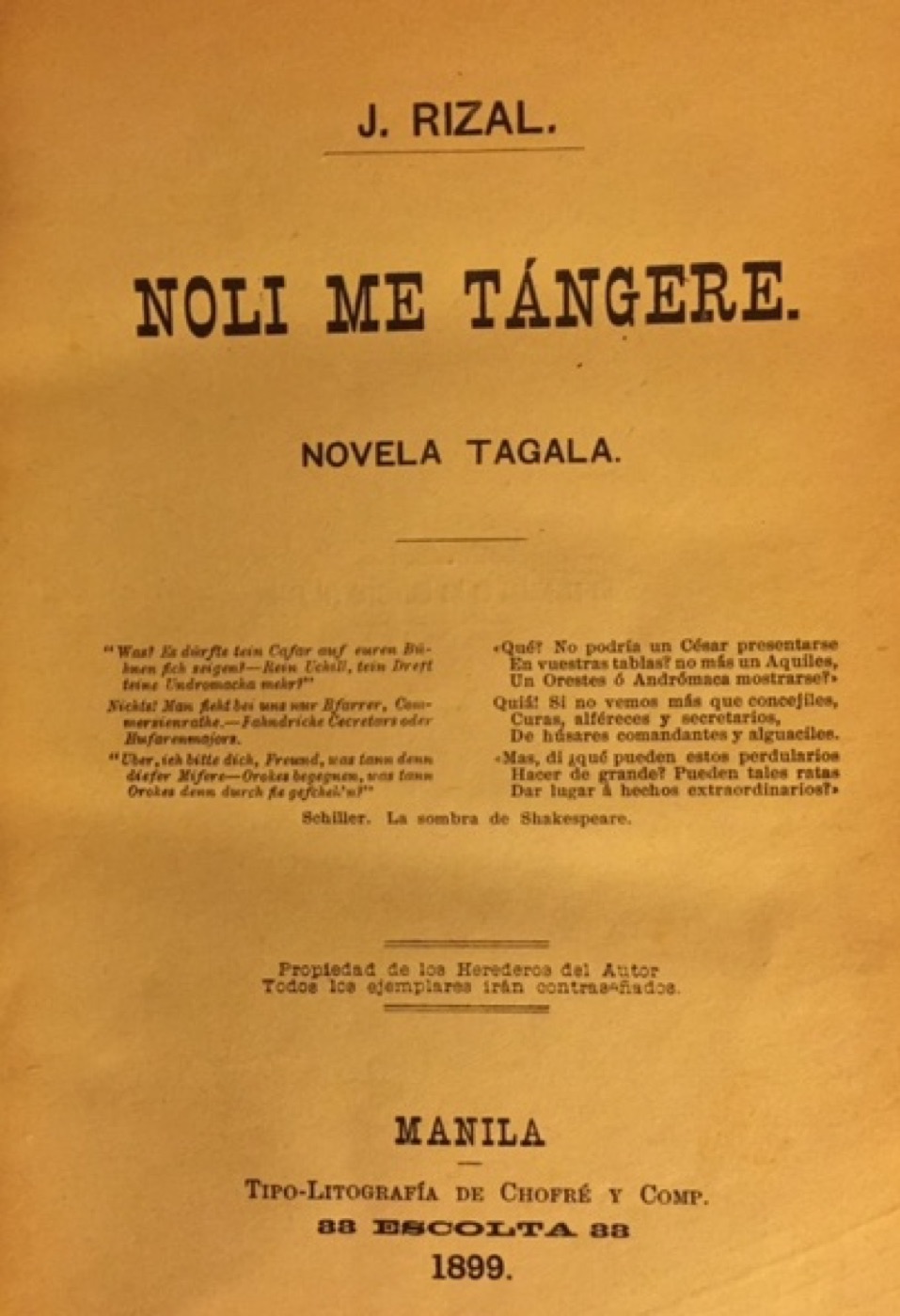
Schlurcher, CC BY 4.0, via Wikimedia Commons. CC BY 4.0 · source page ↗ - The first Philippine edition of Noli Me Tangere, published in Manila in 1899.
Public-domain edition; photograph by Guanyin2, CC BY-SA 4.0. Public domain / CC BY-SA 4.0 · source page ↗ - A facsimile of the 1891 El Filibusterismo cover. The novel was printed in Ghent.
José Rizal, 1891. Public domain. Public domain · source page ↗ - Manuel Arias Rodríguez’s 1896 painting of the execution at Bagumbayan. A later artistic reconstruction, not a photograph.
Manuel Arias Rodríguez, 1896. Museo del Ejército, Madrid. Public domain. Public domain · source page ↗ - An early twentieth-century postcard of the Luneta, before the present monument was completed.
Postcard, early twentieth century. Public domain. Public domain · source page ↗ - The cover of La Liga Filipina’s constitution, 1892.
José Rizal, 1892. Public domain. Public domain · source page ↗ - Rizal’s handwritten regulations for La Liga Filipina.
José Rizal, 1892. Public domain. Public domain · source page ↗ - The 2015 National Historical Commission marker for La Liga Filipina in Manila.
Andre Ryan Maceda, CC BY-SA 4.0, via Wikimedia Commons. CC BY-SA 4.0 · source page ↗ - Rizal’s ophthalmologist business card from Hong Kong, a document of his working life in exile.
José Rizal, late nineteenth century. Free Art License. Free Art License · source page ↗ - A family tree drawn by Rizal in Dapitan, from Austin Craig’s 1913 biography.
José Rizal, 1890s. Public domain. Public domain · source page ↗ - The Rizal plaque in Ghent, marking the city where El Filibusterismo was printed.
Paul Drieghe, CC BY-SA 3.0, via Wikimedia Commons. CC BY-SA 3.0 · source page ↗ - A historical marker connected to “Mi Último Adiós,” the poem Rizal is said to have hidden in a lamp before his execution.
Christian Sangoyo, CC BY-SA 3.0, via Wikimedia Commons. CC BY-SA 3.0 · source page ↗ - The López Jaena monument in Jaro, Iloilo City.
Ralff Nestor Nacor, CC BY-SA 4.0, via Wikimedia Commons. CC BY-SA 4.0 · source page ↗
Method notes
The timeline chart in the interactive edition computes x-position from each record’s start year on a linear 1861–1896 scale. Ranges are retained in labels. Rows are exhibition selections, not a complete inventory of Rizal’s activity.
The relationship graph shows labeled connections established in the novels. Node arrangement and edge length carry no quantitative meaning. It does not purport to show actual historical people. Identity revelations remain in spoiler disclosures.
The Leaflet map uses approximate geographic locations and OpenStreetMap attribution. No fabricated path, inferred itinerary, or invented travel-distance statistic is presented.
Software and type
Leaflet 1.9.4 (BSD-2-Clause) powers the map. Map data and tiles: OpenStreetMap contributors. DM Sans is distributed under the SIL Open Font License. A typography animation is adapted from the installed Design Taste skill’s word-highlight component.
Original exhibition copy and interactive implementation prepared for the student project. This site is an independent learning project, not an official museum or government publication.